Count and Color Math Worksheets: Blending Whimsy with Early Education
For anyone involved in creating educational materials—whether you are a homeschooling parent, a curriculum designer, or a small business owner selling printable resources on platforms like Etsy—visual hierarchy is everything. You are not just selling content; you are selling an experience. The "Count and Color Math Worksheets" concept represents a specific niche of design assets that balances functional education with aesthetic appeal. It is a resource designed to bridge the gap between rigorous early math concepts and the creative freedom of art, making it a valuable tool for your design toolkit.
The Anatomy of Educational Design Assets
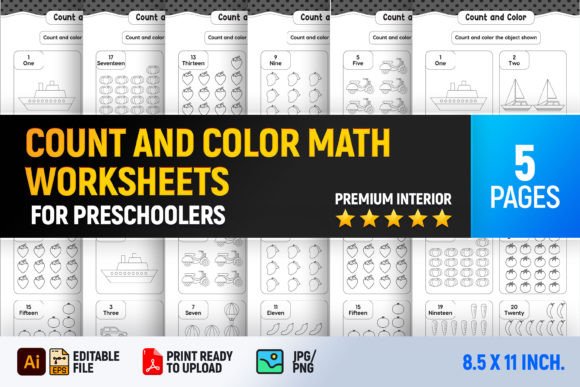
When we look at the "Count and Color Math Worksheets," we are examining more than just a collection of illustrations. This is a structured approach to early childhood education. The visual characteristics of such a resource typically lean towards high-contrast line art. The lines need to be bold enough for developing motor skills to color within, yet distinct enough to clearly define the objects being counted—be they geometric shapes, animals, or everyday items.
The personality of this design style is inherently approachable and encouraging. Unlike a sterile, corporate sans serif font used in a bank report, these worksheets utilize a visual language that speaks to safety and fun. For the designer or content creator, this translates to a specific style of "hand-drawn" aesthetic. It avoids the rigidity of vector-perfect geometry in favor of organic curves that feel human-made. This is crucial for building trust with parents who are looking for materials that feel warm rather than mass-produced.
Strategic Applications in Branding and Marketing
If you are a marketer or brand strategist in the education sector, understanding how to apply resources like the Count and Color Math Worksheets is key to your brand identity. This resource is not just for the classroom; it is a marketing asset. A preschool or daycare center can use these worksheets as a lead magnet—offering a free download in exchange for an email address. The visual consistency of the worksheets reinforces the brand’s promise of providing creative, engaging care.
- Brand Consistency: Using the same style of illustrations across your social media graphics, your website, and your physical handouts creates a cohesive ecosystem. If your brand identity relies on being "creative and educational," these worksheets serve as the proof.
- Visual Hierarchy in Packaging: If you are a crafter selling educational bundles, the cover of your worksheet pack is your "packaging design." The way the "Count and Color" elements are arranged creates a focal point that draws the eye, suggesting value and organization before the customer even reads the description.
- Editorial Design: Bloggers and publishers focusing on parenting niches can break up long blocks of text with snippets from these worksheets. It serves a dual purpose: visual relief for the reader and a demonstration of the practical value being discussed.
Enhancing Audience Engagement
The core value of the Count and Color Math Worksheets lies in its ability to influence audience engagement. In a digital landscape saturated with passive content, interactive printables are a breath of fresh air. They require active participation. For the content creator, this is gold. Engagement metrics aren't just about likes and shares; they are about utility. When a user prints a page, they are investing in your content. This deepens the relationship between the creator and the consumer, fostering a sense of community and loyalty that passive content cannot achieve.
Practical Guidance for Implementation
For the entrepreneur or small business owner, incorporating these worksheets into your workflow requires a strategy that goes beyond simply uploading a PDF. The "Instant Download" nature of modern design assets means your turnaround time is zero, but your curation time must be high.
First, consider the "font pairing" of your educational content. While the worksheet itself uses visual icons rather than typography, the text you use to describe it—the headers, the instructions, the marketing copy—must complement the playful nature of the worksheets. A whimsical script font might work for the title "Count and Color," but the body text explaining the instructions needs to be a highly legible sans serif font to ensure clarity for the parent reading it.
Second, evaluate the file formats provided. A robust design asset package usually includes AI editable files for customization, alongside PDFs for immediate printing and JPGs for digital previews. As a designer, having access to the source files allows you to adapt the worksheets to fit specific client needs—perhaps changing the color palette to match a specific brand identity or resizing elements for different page formats.
Readability and Accessibility
When working with early education materials, readability is paramount. While we often associate this term with typography, in the context of worksheets, it applies to visual clarity. The illustrations must be uncluttered. A child should be able to distinguish between a circle and a square instantly. For the professional creating these assets, this means paying attention to negative space. Overcrowding the page with too many "brain-boosting activities" can lead to cognitive overload for the child and frustration for the parent. The most effective design is often the simplest one, allowing the child's creativity to fill the empty space.
Ultimately, the Count and Color Math Worksheets are more than just a printable; they are a versatile design asset. They offer a way to blend education with art, providing a tangible product that supports developmental milestones while offering a canvas for creative expression. Whether you are building a brand, curating a digital shop, or simply looking for high-quality resources for your audience, integrating this style of thoughtful, interactive design is a practical step toward a more engaging content strategy.